
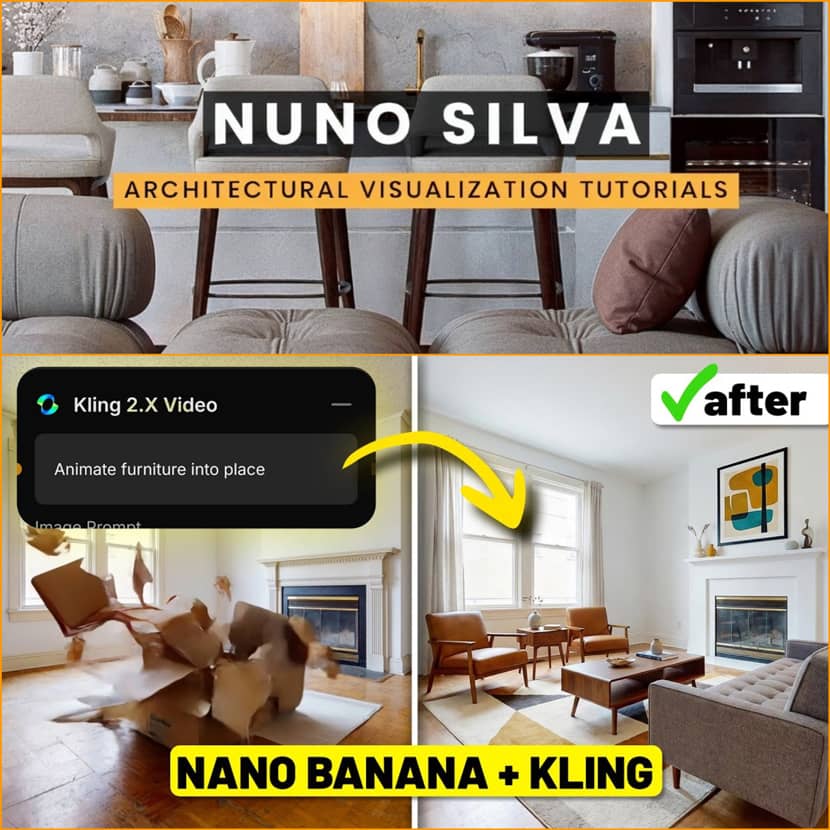
What if artificial intelligence (AI) could instantaneously turn an empty real estate listing into a fully furnished, animated interior with controlled lighting adjustments, morphing styles, and cinematic transitions? In his most recent breakdown, Nuno Silva presents production-ready workflows that are already transforming architectural animation with Nano Banana Pro and Kling!
Turning Empty Interiors Into Cinematic Animations With AI.
Nuno Silva shows how AI can be used for much more than just creating static images in this comprehensive video. He creates reusable, node-based workflows that produce filled spaces, animated furniture placement, design morphing, and even day-to-night transitions from an entirely empty interior while preserving camera consistency and spatial accuracy.
The most important lesson is not only which technologies to utilize, but how to combine them to achieve results that feel intentional, cinematic, and client-ready rather than random AI outputs.
The Foundation: Note-Based AI Workflows In Fuser Studio.
Fuser Studio, a note-based, node-driven environment that enables designers to chain text, image, and video AI models into a single visual canvas, is the central component of the workflow.
Instead of jumping between multiple websites, Nuno uses Fuser Studio to:
- Compare prompts from different LLMs
- Feed the best results directly into image generators
- Reuse the same animation logic across multiple projects
One of the most difficult problems in AI-assisted Archviz is resolved by this method: clearly translating a creative idea into something AI can reliably understand.
Generating The Perfect Base Interior With Nano Banana Pro.
A straightforward language description of an antiquated living room is the first step in the procedure. Nuno finds the strongest cue after running this description through multiple large language models to produce various interpretations of the same concept.
For image generation, Nano Banana Pro stands out for its ability to:
- Preserve camera position and proportions
- Respect architectural boundaries
- Deliver clean, realistic interiors suitable for animation
Without sacrificing spatial consistency, the empty room is convincingly transformed into a contemporary, mid-century-inspired environment by iteratively improving prompts.
Furniture Pop-Up Animations With Kling.
(Performance Center, Proxies & Scene Inspector)
To animate the transformation, Nuno turns to Kling, using a start image (empty interior) and an end image (furnished version).
This method enables:
- Furniture popping smoothly into place
- Locked camera animation without jitter
- High-end visualization suitable for marketing and presentations
Style Morphing: Multiple Interior Designs in One Sequence.
The video's demonstration of creating multiple interior styles simultaneously is one of its more amazing parts. Nuno creates multiple distinct design variations by copying nodes and passing the same empty interior into various prompts.
These designs are then animated using Kling to create:
- Seamless cinematic morphing between styles
- Smooth furniture and decor transformations
- Continuous camera-locked transitions
After rendering, the clips are put together in Adobe Premiere, where minor sound effects and camera zooms give the finished presentation a polished appearance.
Day-to-Night Timelapse with Controlled Lighting.
Nuno investigates day-to-night transitions in addition to furniture animation. He links both photos as start and finish frames in Kling by creating a second internal image with warm interior tones and blue-hour illumination.
The outcome is a controlled, aesthetically beautiful lighting transition that avoids the randomness sometimes found in AI video, demonstrating that organized inputs are essential to predictable results.
Where AI Still Struggles (And Why That Matters).
Nuno is transparent about AI’s current limitations. Particularly when contrasted with more conventional approaches like Lumion phasing or 3ds Max particle systems, physics-based furniture movement is still uneven.
Classic programs like Lumion and 3ds Max still provide more control for intricate simulations. However, AI methods significantly shorten production times for quick idea animations and design research.
A Glimpse into the Future of ArchViz Workflows.
This breakdown's realism is what makes it so valuable. When applied carefully, AI is positioned as a potent accelerator rather than a substitute for conventional archviz tools.
Nuno Silva illustrates methods that are not only creative but also repeatable, scalable, and financially feasible by combining Kling for animation, Nano Banana Pro for picture consistency, and a node-based logic inside Fuser Studio.
🎥 Watch the full tutorial below:
About Nuno Silva.
Nuno Silva is a Portugal-based 3D artist and educator specializing in architectural visualization. With more than a decade of experience creating renders for international clients, he is known for combining technical clarity with cinematic storytelling. Through his online courses, tutorials, and carefully structured workflows, he helps thousands of artists develop professional-level rendering skills in Lumion, and other visualization tools. His teaching style focuses on efficiency, realism, and creativity, allowing beginners and advanced users alike to elevate their architectural presentations.