
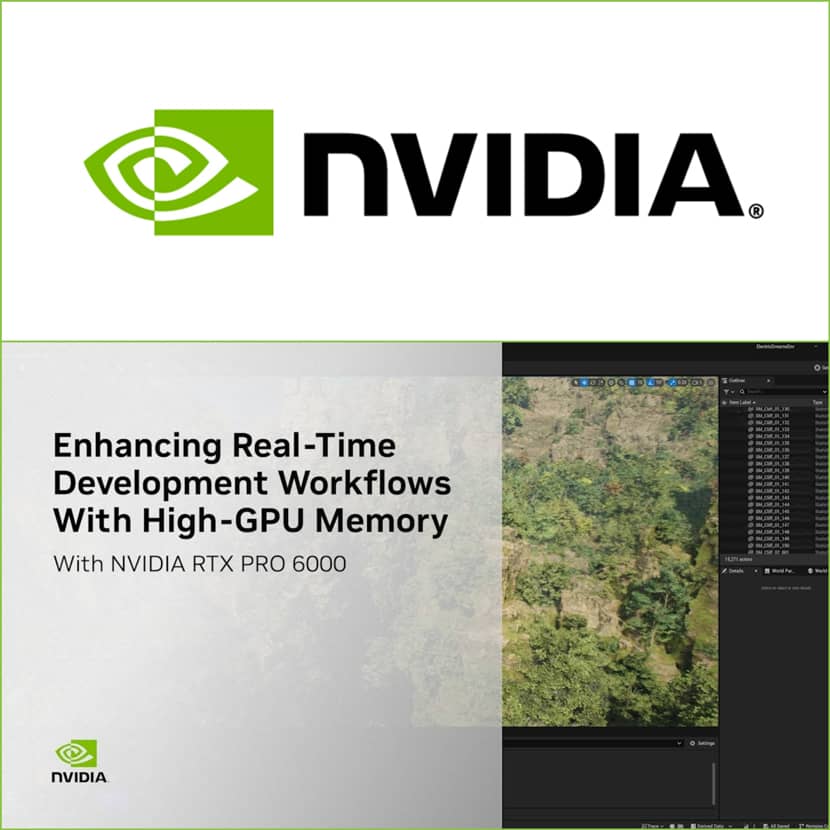
Real-time creation is getting heavier, smarter, and more demanding than ever. GPU RAM has subtly emerged as the true obstacle in everything from local Generative AI procedures to Real-Time 3D scenes. NVIDIA’s latest flagship GPU changes the rules by unlocking uninterrupted, multi-app real-time development like never before!
A new era in real-time development has begun, one that is characterized by available GPU memory and its efficient utilization in addition to raw GPU performance. Developers are increasingly encountering a crucial constraint as contemporary projects push the limits of visual fidelity, interaction, and AI-assisted creation: VRAM capacity.
High GPU memory radically changes real-time workflows, particularly when working with massive scenes, sophisticated texturing pipelines, and local Generative AI tools in parallel, as seen in NVIDIA's most recent technical showcase.
The Hidden Cost of Real-Time Complexity.
Modern real-time projects are no longer lightweight environments as they combine:
- Dense geometry and high-resolution assets
- Advanced shaders and layered materials
- Complex animations and simulations
- Large open environments designed for immersion
All of this must remain interactive, responsive, and stable during development.
Playtesting, which involves constantly switching between the editor and a standalone build to assess performance, visual quality, and asset optimization, is an essential component of the workflow. The GPU RAM is under tremendous strain due to this frequent context change.
More than 16 GB of VRAM are already used in the demonstrated project just to load a sizable real-time-ready scene. Requirements are instantly exceeded by 30 GB when a solo build is started, and further scene exploration results in dedicated GPU memory use exceeding 35 GB.
These workflows come to a complete stop in the absence of enough GPU memory, forcing developers to shut down programs, wait for memory to free up, or transfer work to other machines.
Why “Enough” VRAM Is No Longer Enough.
The video highlights a crucial point that many real-time specialists are already familiar with: during development, you usually need about double the VRAM requirements of the final project. Because development environments must simultaneously execute the editor, a standalone build, supporting tools like texturing, simulation, and AI applications, as well as debugging and profiling systems, this extra buffer is crucial. When VRAM is insufficient, the impact goes far beyond reduced performance, leading instead to workflow interruptions, loss of creative context, and significant waste of valuable development time.
Texturing Meets Generative AI: A Memory-Intensive Reality.
The video showcases a real-world asset workflow focused on hero cliff elements, where textures are:
- Projected
- Layered
- Fine-tuned for realism
Traditional tools like Adobe Substance Painter are used alongside local Generative AI workflows powered by ComfyUI which is a node-based, highly customizable system that enables local, GPU-based generative texture creation, offering reduced latency, higher performance, and full control without cloud dependency. However, this power comes at a cost, as ComfyUI alone can demand 15–20 GB of VRAM.
Developers are frequently forced to make bad choices when using their 3D software, such as shutting down the tool to free up memory, running AI tools on a different computer, or installing multiple GPUs just to stay productive—all of which disrupt creative momentum and fragment workflow.
Enter Blackwell: A New Class of Professional GPU.
This is where NVIDIA’s latest architecture steps in. Built on the new Blackwell platform, the NVIDIA RTX PRO 6000 is positioned as a flagship GPU for professional graphics and development, not gaming.
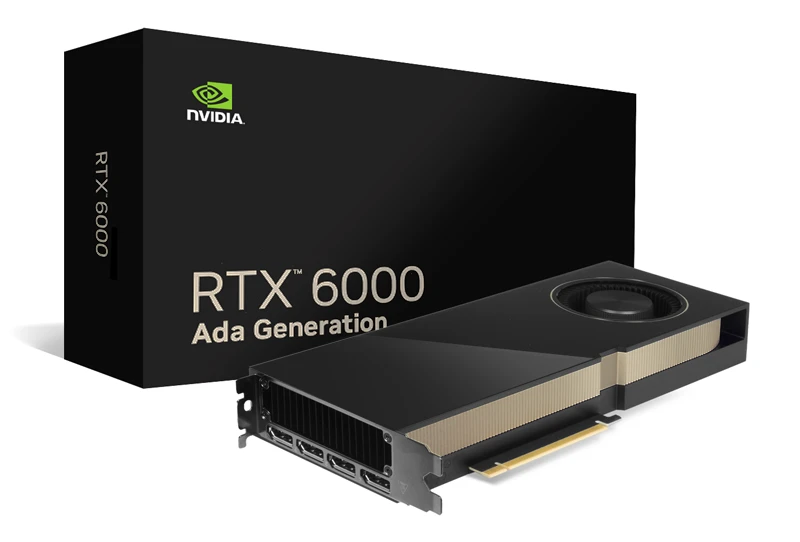
Its distinguishing feature is simple but revolutionary: 96 GB of GPU memory, a large VRAM pool that enables developers to run the software's Editor and a standalone build concurrently, run local Generative AI workflows in parallel, keep all supporting applications open on a single GPU, and maintain seamless, continuous iteration, allowing memory-heavy AI tools, real-time engines, and DCC applications to coexist without compromise, with VRAM to spare.
One GPU, One Workflow, Zero Interruptions.
The practical impact of high GPU memory is not theoretical—it’s deeply experiential:
- No shutdowns to reclaim VRAM
- No waiting for assets to reload
- No switching machines or GPUs
- No creative momentum loss
Instead, developers can iterate faster, test more often, and maintain a fully live creative environment.
For studios working on:
- Real-time cinematics
- Virtual production
- Games and simulations
- Architectural visualization
- Immersive XR experiences
This represents a fundamental shift in how work gets done.
Blackwell and the Next Chapter of Creative Workflows.
By providing unmatched memory scale, high efficiency under demanding workloads, seamless AI and real-time integration, and future-ready performance for developing pipelines, Blackwell builds on generations of NVIDIA innovation and defines the next phase of professional GPU computing. This enables hardware to finally keep up with creative ambition rather than requiring creators to modify their workflows to accommodate technical constraints.
Why High GPU Memory Is Now a Strategic Advantage.
As real-time development and AI-assisted creation converge, GPU memory is no longer a simple spec-sheet detail but a strategic production resource, as high VRAM enables faster iteration cycles, fewer technical compromises, higher-quality final output, and more resilient, scalable pipelines. That means GPUs like the RTX PRO 6000 aren’t just faster, but redefine what’s practically possible within a single workstation.
Watch the full video presentation and explore how RTX PRO 6000 is able to enhance Real-Time workflows<:
About Nvidia:
NVIDIA is a global leader in accelerated computing, pioneering advancements in graphics, artificial intelligence, and high-performance computing. Its professional GPU solutions power industries ranging from real-time 3D and visual effects to AI research, simulation, and digital twins. With the introduction of the Blackwell architecture, NVIDIA continues to push the boundaries of what creators, developers, and studios can achieve—unlocking new levels of performance, scale, and creative freedom in modern workflows.